Introduction
Choosing the right CSS framework is one of the most important decisions when developing a modern website. A good framework not only speeds up the development process but also plays a significant role in website performance, user experience, and search engine rankings. As Google’s Core Web Vitals continue to influence SEO and overall website quality, developers are paying closer attention to how their CSS framework impacts loading speed, layout stability, and responsiveness.
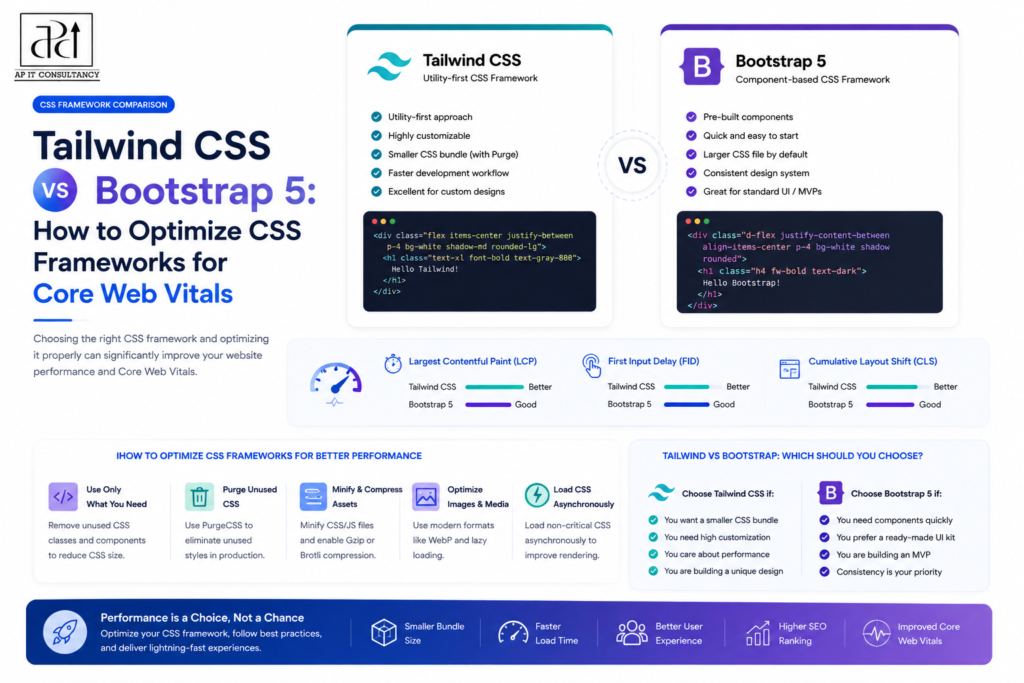
Among the most popular options available today are Tailwind CSS and Bootstrap 5. Both frameworks have earned strong reputations for helping developers build responsive and visually appealing websites, yet they follow very different approaches. Bootstrap provides a collection of pre-designed components that make development fast and consistent, while Tailwind CSS focuses on utility-first classes that give developers complete control over every aspect of a design.
Although both frameworks can produce excellent websites, poor implementation can negatively affect Core Web Vitals. Unused CSS, unnecessary JavaScript, oversized assets, and inefficient layouts can all reduce performance regardless of the framework you choose. Understanding how to optimize these frameworks is just as important as selecting the right one.
In this article, we’ll compare Tailwind CSS and Bootstrap 5, examine their strengths and weaknesses, and explore practical techniques to optimize both frameworks for better Core Web Vitals and improved website performance.
Understanding Core Web Vitals
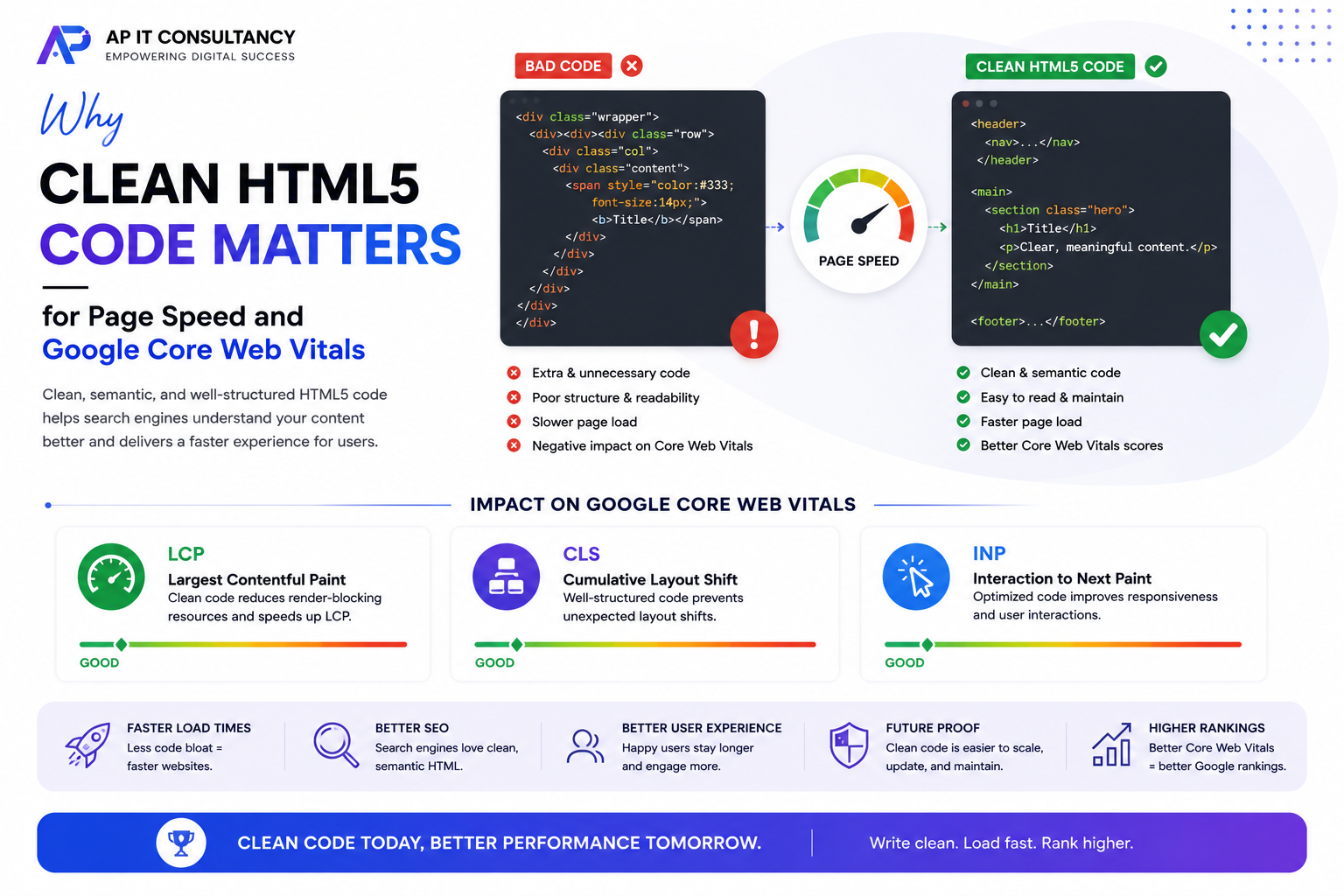
Core Web Vitals are Google’s performance metrics designed to measure how users experience a website. Instead of focusing only on loading speed, these metrics evaluate real-world usability and responsiveness.
The three primary metrics include Largest Contentful Paint (LCP), which measures loading performance, Interaction to Next Paint (INP), which evaluates responsiveness, and Cumulative Layout Shift (CLS), which measures visual stability during page loading.
A website that performs well in these areas typically loads faster, responds quickly to user interactions, and maintains a stable layout without unexpected movement. These improvements contribute to higher user satisfaction and can positively influence search engine rankings.
Whether you choose Tailwind CSS or Bootstrap 5, optimizing these metrics should remain a priority throughout the development process.
What Makes Tailwind CSS Different?
Tailwind CSS follows a utility-first philosophy that allows developers to build custom designs directly within HTML using small utility classes.
Instead of relying on predefined components, developers combine utility classes to create unique layouts without writing large amounts of custom CSS. This approach provides exceptional flexibility while keeping design systems highly consistent.
One of Tailwind’s biggest advantages is its ability to remove unused styles during production builds. Since only the utility classes actually used in the project are included, the final CSS file is often much smaller than traditional frameworks.
This reduction in CSS size can significantly improve page loading speed, especially on content-heavy websites and modern web applications.
Tailwind also integrates well with modern JavaScript frameworks such as React, Vue, Next.js, Nuxt, and Laravel, making it a popular choice among professional developers.
Understanding Bootstrap 5
Bootstrap remains one of the most widely used frontend frameworks in the world because of its simplicity and extensive component library.
It includes responsive grids, navigation bars, forms, buttons, cards, modals, alerts, carousels, and many other ready-made components that help developers build websites quickly.
Bootstrap’s standardized design language reduces development time while ensuring consistent layouts across different browsers and devices.
Version 5 introduced significant improvements by removing the dependency on jQuery, reducing file sizes, and improving overall performance compared to previous versions.
For business websites, landing pages, dashboards, and corporate portals, Bootstrap continues to provide an efficient solution with excellent documentation and community support.
Performance Comparison
When performance is the primary goal, Tailwind CSS often has an advantage because of its optimized production builds.
Unused utility classes are automatically removed during compilation, leaving only the CSS required for the project. Smaller CSS files reduce render-blocking resources and help improve Largest Contentful Paint.
Bootstrap includes many predefined components, even if only a small percentage are used. Without customization, websites may load unnecessary styles that increase file size.
However, Bootstrap can also be optimized by compiling custom builds and excluding unused components. Developers who carefully configure Bootstrap can achieve impressive performance without sacrificing development speed.
Ultimately, performance depends more on implementation than on the framework itself.
Optimizing Tailwind CSS for Core Web Vitals
Tailwind CSS offers several built-in optimization opportunities.
Always enable production builds to remove unused utility classes. This single step dramatically reduces CSS file size.
Minify CSS files before deployment and compress assets using Gzip or Brotli compression.
Avoid creating extremely large HTML structures filled with unnecessary utility classes. Keeping markup clean improves readability and long-term maintenance.
Use responsive images, lazy loading, and modern image formats like WebP or AVIF to reduce loading times.
Combining Tailwind with server-side rendering or static site generation further improves performance and helps achieve excellent Core Web Vitals scores.
Optimizing Bootstrap 5 for Core Web Vitals
Bootstrap websites can perform extremely well when optimized properly.
Rather than importing the entire framework, compile a custom Bootstrap build containing only the components your project requires.
Minify CSS and JavaScript files before deployment.
Load JavaScript asynchronously whenever possible to reduce render-blocking resources.
Replace large image files with optimized alternatives and use lazy loading for below-the-fold content.
Avoid excessive use of third-party plugins that introduce additional CSS and JavaScript files.
Regular performance audits using Lighthouse or PageSpeed Insights help identify opportunities for further optimization.
Responsive Design and Mobile Performance
Both frameworks provide responsive grid systems that adapt layouts across different screen sizes.
Tailwind offers greater flexibility because developers define responsive behavior directly through utility classes.
Bootstrap simplifies responsive development using predefined breakpoints and component behavior, making it easier for beginners.
Regardless of framework choice, mobile performance should remain a top priority. Responsive typography, properly sized touch targets, optimized images, and efficient layouts contribute significantly to better user experience and improved Core Web Vitals.
Developer Experience
Tailwind CSS appeals to developers who want complete design freedom.
Instead of overriding predefined styles, every interface can be built exactly as required while maintaining consistent spacing, typography, and colors through configuration files.
Bootstrap focuses on rapid development using ready-made components. Teams can produce polished interfaces quickly without extensive custom styling.
For organizations building internal tools, dashboards, or business websites, Bootstrap often reduces development time considerably.
Projects requiring unique branding and highly customized interfaces frequently benefit from Tailwind’s flexible architecture.
Which Framework Should You Choose?
There is no universal winner between Tailwind CSS and Bootstrap 5.
Tailwind is an excellent choice for developers seeking maximum customization, smaller production CSS files, and modern development workflows. It works particularly well for SaaS applications, custom business platforms, startups, and projects requiring distinctive branding.
Bootstrap remains ideal for rapidly developing responsive websites using professionally designed components. Corporate websites, administrative dashboards, educational portals, and small business websites continue to benefit from Bootstrap’s mature ecosystem and extensive documentation.
The right choice depends on your project requirements, development team, design goals, and maintenance strategy.
Final Thoughts
Tailwind CSS and Bootstrap 5 are both outstanding frontend frameworks capable of producing fast, responsive, and visually appealing websites. While their philosophies differ, both can achieve excellent Core Web Vitals scores when implemented using modern performance optimization techniques.
Tailwind provides unmatched flexibility and naturally smaller production CSS through its utility-first approach, making it attractive for highly customized applications. Bootstrap delivers speed of development, consistent components, and a proven ecosystem that continues to evolve with modern web standards.
Rather than focusing solely on which framework is faster, developers should prioritize efficient coding practices, optimized assets, minimal dependencies, responsive design, and continuous performance monitoring. By combining the strengths of either framework with thoughtful optimization, businesses can create websites that load quickly, deliver exceptional user experiences, and perform well in search engine rankings while remaining scalable for future growth.