Introduction
As modern web applications become more sophisticated, choosing the right frontend architecture has become one of the most important decisions for developers and businesses alike. Whether you’re building a SaaS platform, an enterprise dashboard, a large eCommerce store, or a customer portal, your application’s architecture directly affects performance, scalability, development speed, and long-term maintenance.
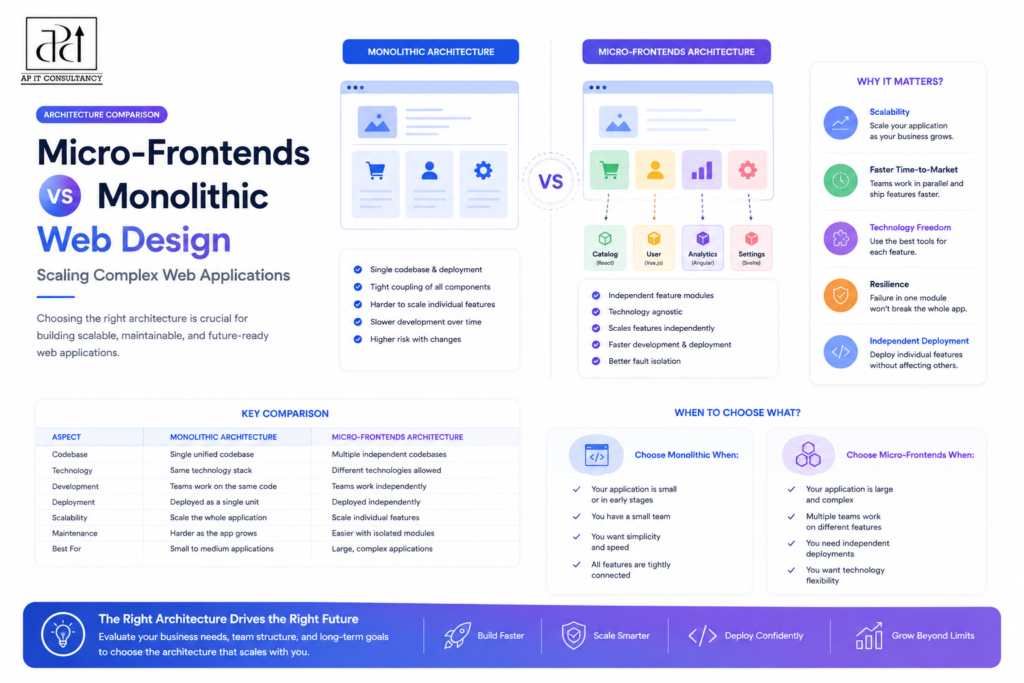
For years, monolithic web design was the standard approach. Everything—from the user interface to business logic—was developed, tested, and deployed as a single application. While this method works well for smaller projects, it often becomes difficult to manage as applications grow in size and complexity.
To overcome these limitations, many organizations have started adopting Micro-Frontends, an architectural approach that breaks a large frontend into smaller, independently developed applications. Inspired by the success of microservices, Micro-Frontends allow multiple development teams to work on different sections of a web application simultaneously without interfering with each other’s code.
Both approaches have unique strengths, and choosing between them depends on your project’s size, team structure, performance goals, and future growth plans. Understanding the differences can help businesses make informed decisions and build applications that remain scalable for years to come.
Understanding Monolithic Web Design
Monolithic web design follows a traditional development model where the entire frontend is built as one unified application. Every page, feature, component, and user interface element exists within a single codebase.
This architecture is straightforward and works exceptionally well for small and medium-sized websites. Developers can manage everything from one project, making deployment relatively simple and reducing the need for complex infrastructure.
Since all application components are closely connected, introducing new features is often easier during the early stages of development. Testing is centralized, version control is simpler, and developers have complete visibility into the application.
However, as the application grows, maintaining a large codebase becomes increasingly challenging. Even small updates may require rebuilding and redeploying the entire application, slowing development and increasing the risk of introducing unexpected bugs.
What Are Micro-Frontends?
Micro-Frontends apply the same philosophy as microservices to frontend development.
Instead of building one large application, developers divide the frontend into multiple independent modules. Each module represents a specific feature or business domain and can be developed, tested, and deployed independently.
For example, an eCommerce platform might separate its homepage, product catalog, shopping cart, customer dashboard, and checkout process into individual frontend applications. Different development teams can own each module while maintaining consistent branding and user experience across the website.
These independent applications communicate through shared APIs, routing systems, or module federation technologies, allowing businesses to scale development without creating unnecessary dependencies.
Scalability Comparison
Scalability is often the biggest reason organizations consider Micro-Frontends.
A monolithic application grows as a single codebase. Every new feature increases complexity, making development slower over time. Large teams frequently encounter merge conflicts, deployment bottlenecks, and lengthy testing cycles because every change affects the entire application.
Micro-Frontends solve this challenge by allowing individual teams to focus on specific modules. Since each section operates independently, developers can release updates without waiting for the entire application to be rebuilt.
This modular approach makes scaling much easier, especially for enterprise platforms serving millions of users.
Development Speed and Team Productivity
Development workflows differ significantly between these two architectures.
With a monolithic frontend, every developer contributes to the same project. While collaboration is simple for smaller teams, productivity often decreases as more developers join the project.
Micro-Frontends encourage parallel development. Multiple teams can simultaneously build new features, fix bugs, and release updates without interfering with one another.
This independence significantly shortens release cycles and enables organizations to deliver improvements more frequently.
Large technology companies often adopt this model because it supports continuous deployment across multiple teams.
Performance Considerations
Performance depends largely on implementation rather than architecture alone.
A well-optimized monolithic application can deliver excellent performance for many years. Since everything loads together, users benefit from fewer network requests and consistent application behavior.
However, large monolithic applications may eventually become heavier as additional features, scripts, and dependencies accumulate.
Micro-Frontends can improve performance by loading only the modules users actually need. This reduces initial page size and improves perceived loading speed.
On the other hand, poor implementation may introduce additional JavaScript bundles, duplicate libraries, and increased network requests, reducing performance instead of improving it.
Careful optimization remains essential regardless of the chosen architecture.
Maintenance and Long-Term Growth
Maintaining software becomes more difficult as applications expand.
In monolithic projects, updating one component often requires understanding unrelated sections of the application. Legacy code, tightly coupled dependencies, and shared components can make simple improvements unexpectedly complex.
Micro-Frontends simplify maintenance by isolating functionality into independent modules. Teams can modernize individual sections without affecting the entire application.
This flexibility allows businesses to adopt new technologies gradually instead of rebuilding everything at once.
For organizations planning long-term growth, this modular approach often reduces technical debt and improves maintainability.
Technology Flexibility
One advantage of Micro-Frontends is technological independence.
Different teams can use different frontend frameworks when appropriate. For example, one module may use React, another Vue, and another Angular, provided integration standards remain consistent.
This flexibility allows organizations to adopt newer technologies without rewriting their entire application.
Monolithic applications generally rely on a single framework throughout the project, making future migrations more challenging.
While technology diversity offers flexibility, businesses should establish clear development standards to avoid unnecessary complexity.
Security Considerations
Security remains important regardless of architecture.
Monolithic applications benefit from centralized authentication, authorization, and security policies, making implementation relatively straightforward.
Micro-Frontends require careful coordination because multiple independent applications interact within the same platform. Authentication, API security, shared sessions, and data protection must remain consistent across every module.
When implemented correctly, both architectures can achieve excellent security standards.
Regular updates, secure APIs, strong authentication, and continuous monitoring remain essential best practices.
Deployment Strategies
Deployment is another area where these architectures differ significantly.
A monolithic application usually requires deploying the entire frontend whenever changes are made. Even minor updates may trigger a complete production deployment.
Micro-Frontends allow independent deployment of individual modules. Teams can release improvements, bug fixes, or new features without impacting unrelated sections of the application.
This reduces downtime, speeds up delivery, and enables businesses to respond more quickly to customer feedback.
Continuous Integration and Continuous Deployment (CI/CD) pipelines become especially valuable in Micro-Frontend environments.
Which Architecture Is Right for Your Business?
Choosing between Monolithic Web Design and Micro-Frontends depends on your business goals.
Small businesses, startups, blogs, portfolios, and company websites generally benefit from a monolithic architecture because it’s easier to develop, maintain, and deploy.
Growing SaaS products, enterprise applications, financial platforms, healthcare systems, online marketplaces, and large eCommerce websites often benefit from Micro-Frontends due to improved scalability and independent development.
Organizations should also consider team size, project complexity, expected traffic, deployment frequency, and long-term maintenance costs before making a decision.
Selecting the right architecture early can prevent expensive migrations in the future.
Final Thoughts
Both Monolithic Web Design and Micro-Frontends remain valuable architectural approaches, each serving different business needs. A monolithic architecture offers simplicity, faster initial development, and easier management for smaller applications, making it an excellent choice for projects with limited complexity or smaller development teams.
Micro-Frontends, however, provide unmatched flexibility for organizations building large-scale applications. Independent deployments, modular development, better scalability, and improved team productivity make this architecture increasingly popular among enterprise businesses and rapidly growing digital platforms.
Rather than asking which approach is universally better, businesses should focus on which architecture aligns with their current requirements and future goals. By carefully evaluating project size, team structure, expected growth, and technical resources, organizations can build modern web applications that remain reliable, maintainable, and ready to scale as user demands continue to evolve.