Introduction
When creating a single-page landing website, one of the first decisions developers and business owners face is whether to build it using pure HTML5 or rely on a full-featured Content Management System (CMS) such as WordPress, Joomla, or Drupal. While both approaches can produce attractive and functional websites, they differ significantly in terms of speed, performance, flexibility, maintenance, security, and long-term scalability. Choosing the right solution depends on your project’s goals, technical requirements, and future growth plans.
Single-page landing sites are commonly used for product launches, SaaS applications, startup websites, marketing campaigns, agency portfolios, online events, mobile app promotions, lead generation, and personal brands. Since these websites are often designed to encourage visitors to complete a specific action—such as submitting a contact form, downloading an application, requesting a demo, or making a purchase—they must be fast, visually engaging, and easy to navigate. Every second of loading time and every design decision can influence conversion rates.
Pure HTML5 websites are known for their lightweight structure and excellent performance because they contain only the essential code required to display content. In contrast, CMS platforms provide powerful content management capabilities, plugin ecosystems, and user-friendly dashboards, but they often include additional scripts, databases, and background processes that may not be necessary for a simple landing page.
Understanding the strengths and limitations of both approaches will help you choose the most suitable solution for your project. This article compares Pure HTML5 and heavy CMS platforms across performance, SEO, security, maintenance, scalability, and development efficiency to help you make an informed decision.
What Is a Pure HTML5 Landing Page?
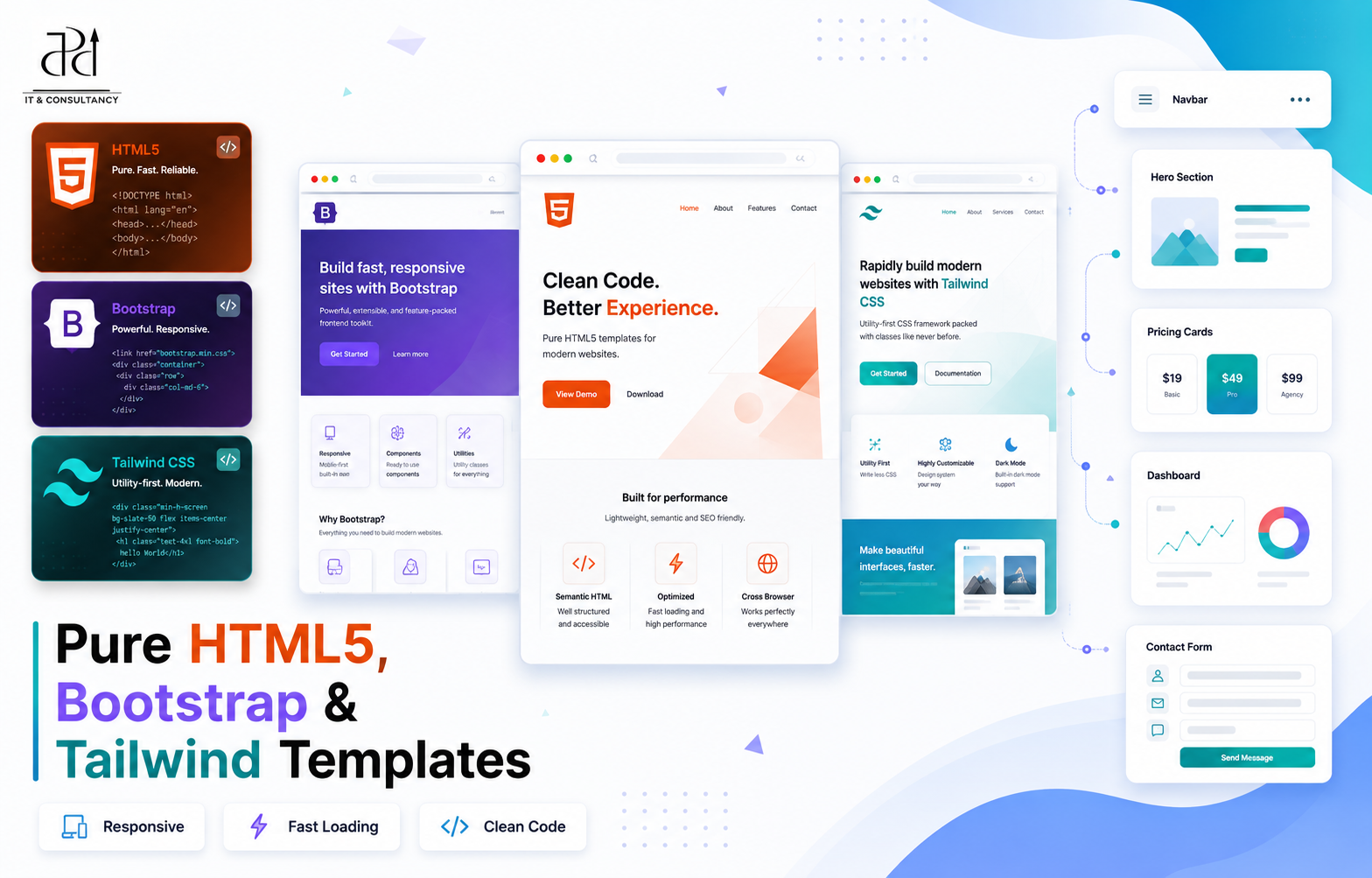
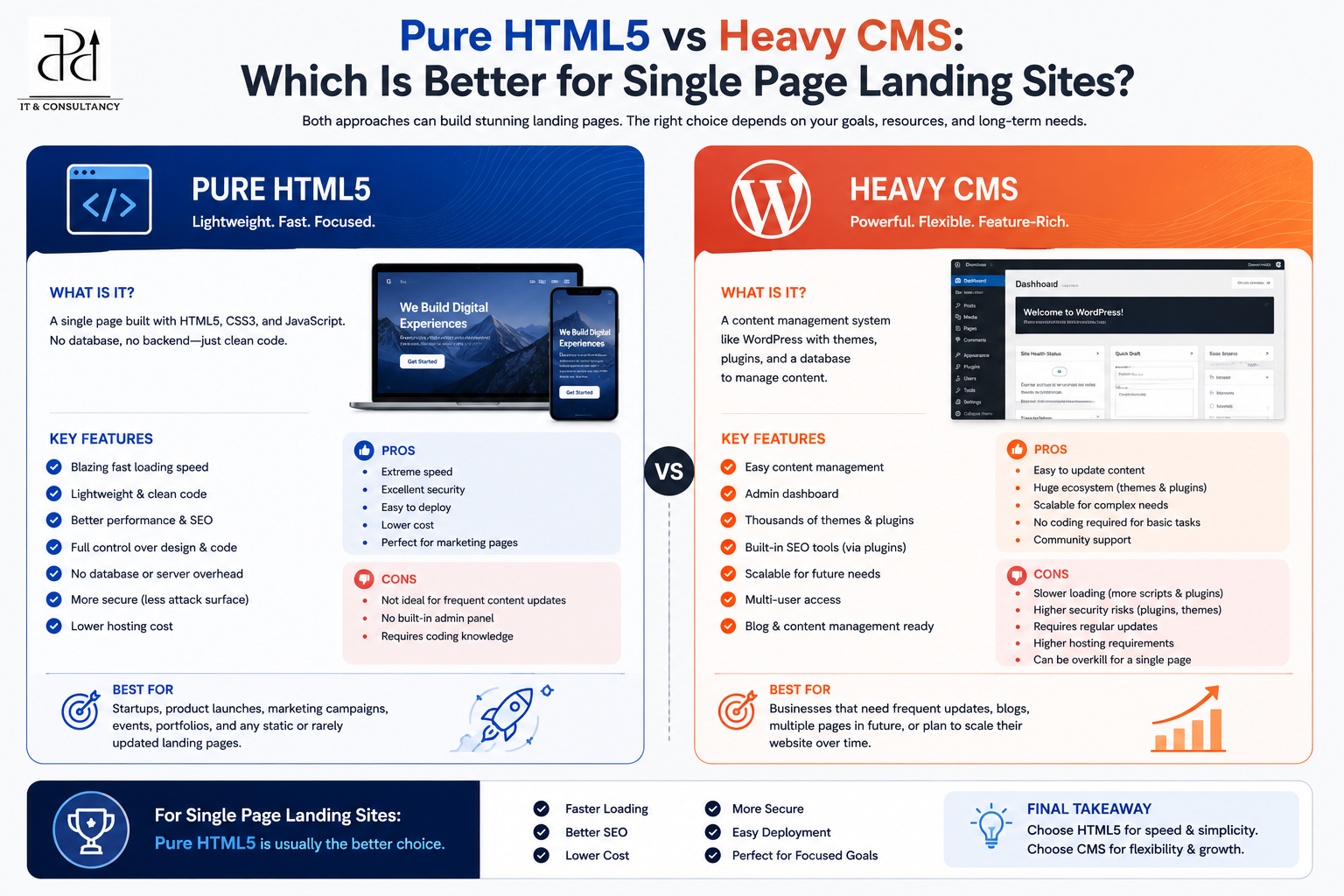
A Pure HTML5 landing page is built using standard web technologies such as HTML5, CSS3, and JavaScript without depending on a content management system.
Since there are no databases, themes, or unnecessary backend processes, the website remains lightweight and highly optimized.
Developers have complete control over every line of code, allowing them to create clean, efficient, and fast-loading pages.
Pure HTML5 websites are especially popular for marketing campaigns, startup launches, agency portfolios, and promotional microsites.
What Is a Heavy CMS?
A heavy CMS refers to a full-featured content management system that includes user authentication, database management, plugin support, themes, media libraries, dashboards, and extensive administrative features.
Platforms like WordPress offer tremendous flexibility for managing large websites with frequent content updates.
However, many of these features remain unused on simple landing pages while still consuming server resources.
The additional complexity can increase loading times if the website is not carefully optimized.
Website Speed and Performance
Performance is one of the biggest differences between the two approaches.
Pure HTML5 websites load extremely quickly because they consist only of static files with minimal processing.
There are no database queries, unnecessary plugins, or large backend systems running behind the scenes.
Heavy CMS platforms often require server-side processing, plugin execution, database communication, and additional assets before rendering a page.
Although optimization techniques can improve CMS performance, Pure HTML5 usually delivers faster loading speeds for single-page websites.
Better Core Web Vitals
Google’s Core Web Vitals measure real user experience based on loading performance, responsiveness, and visual stability.
Pure HTML5 websites naturally achieve stronger Core Web Vitals because developers control every resource being loaded.
With optimized images, lightweight CSS, and minimal JavaScript, performance scores often improve significantly.
CMS websites can also achieve excellent scores, but they generally require more optimization due to additional plugins and background processes.
SEO Comparison
Both Pure HTML5 and CMS platforms can rank well in search engines when implemented correctly.
Pure HTML5 provides clean semantic markup, optimized metadata, structured content, and lightweight pages that search engines can crawl efficiently.
CMS platforms simplify content publishing and SEO management through plugins, making them attractive for websites with regularly updated content.
For static landing pages focused on a single product or campaign, HTML5 often provides excellent SEO performance with fewer technical complications.
Ease of Content Updates
Content management is where CMS platforms offer a clear advantage.
Non-technical users can update text, images, blogs, and pages through an intuitive dashboard without editing source code.
Pure HTML5 websites typically require manual file updates using a code editor or deployment process.
If content changes frequently, a CMS may save significant time.
However, if updates are rare, HTML5 remains a practical and efficient solution.
Security Advantages
Static HTML5 websites have a smaller attack surface because they do not rely on databases, plugins, login panels, or administrative dashboards.
With fewer moving parts, there are fewer opportunities for attackers to exploit vulnerabilities.
CMS platforms require regular updates for themes, plugins, and core software to remain secure.
While properly maintained CMS websites are generally safe, Pure HTML5 naturally reduces many common security risks.
Development Flexibility
Developers enjoy complete creative freedom when building with HTML5.
There are no theme limitations or plugin dependencies restricting design decisions.
Every element can be customized exactly according to project requirements.
CMS platforms also support extensive customization, but developers often work within predefined structures established by themes and plugins.
Pure HTML5 offers maximum flexibility for highly customized landing page designs.
Hosting Requirements
HTML5 landing pages require minimal hosting resources.
Static websites can be hosted on inexpensive shared hosting, cloud storage, Content Delivery Networks (CDNs), or static hosting platforms.
Since there is no server-side processing, operating costs remain low.
CMS platforms require PHP, databases, server configuration, and additional hosting resources to support backend functionality.
This typically increases hosting complexity and maintenance requirements.
Scalability Considerations
If your landing page may eventually evolve into a large business website with blogs, user accounts, e-commerce, or multiple content sections, a CMS provides greater long-term scalability.
Managing large content libraries becomes much easier through administrative dashboards.
Pure HTML5 is ideal for focused projects that prioritize performance over content management.
Future expansion plans should influence your initial technology choice.
Maintenance Requirements
HTML5 websites require very little ongoing maintenance.
There are no plugin updates, database optimization tasks, or software compatibility issues to manage.
Routine maintenance usually involves updating content and monitoring hosting performance.
CMS websites require continuous attention, including software updates, plugin maintenance, backups, security monitoring, and compatibility testing.
Maintenance responsibilities increase as websites become more complex.
Which Option Is Better?
Neither approach is universally better—it depends entirely on project requirements.
Choose Pure HTML5 if your priority is maximum speed, lightweight performance, strong Core Web Vitals, improved security, and a simple landing page with infrequent content updates.
Choose a CMS if you need regular content publishing, multiple contributors, blog management, user-friendly administration, and future expansion into a larger website.
Understanding your long-term business goals will help determine the most appropriate solution.
Final Thoughts
Both Pure HTML5 and heavy CMS platforms have important strengths, but they serve different purposes. Pure HTML5 excels when building fast, secure, and lightweight single-page landing websites focused on performance, user experience, and high conversion rates. Its clean architecture, minimal maintenance, and excellent Core Web Vitals make it an ideal choice for startups, agencies, product launches, and marketing campaigns where speed is a top priority.
On the other hand, CMS platforms remain the better option for businesses requiring frequent content updates, blogs, multiple administrators, and long-term scalability. Before selecting either approach, carefully evaluate your website’s goals, expected growth, maintenance capabilities, and content strategy. Choosing the right foundation from the beginning will help create a landing page that not only performs well today but also supports your business objectives well into the future.